Information Diffusion on Microblogs:
Testing the Threshold Hypothesis of Interpersonal Effects
Cheng-Jun Wang
The 2013 Asian Symposium of Doctoral Students in Communication
2013 Nov 18

Introduction
- Microblogs gain great popularities in the past years.
1. Created in 2006, over 340 million tweets daily. By 2012, 500
million registered users on Twitter, and 200 million active users;
2. In China, there are 400 million registered users on Sina Weibo by
February 2012, and 300 million are active (Wikipedia, 2012)
million registered users on Twitter, and 200 million active users;
2. In China, there are 400 million registered users on Sina Weibo by
February 2012, and 300 million are active (Wikipedia, 2012)
- Yet little is known about to what extent ...
- Whether two regimes of social influence exist
Microblogs and Information Diffusion
Microblog is a broadcast medium in the form of blogging (Microblogging, 2013)
1. information sharing websites (ISWs)
2. needs little or even no emotional attachment
3. networked public
1. information sharing websites (ISWs)
2. needs little or even no emotional attachment
3. networked public
Three categories: retweets, conversations (replies or comments), monologues
Two features: hashtags and URLs
Projet Cascade (R&D NYTimes Labs)
News sharing on Twitter
For a specific tweet:
On Twitter, only those who directly retweet
the original tweet will appear in the
webpage of the original tweet
(those who retweet the retweeters will
not be listed).
On Sina Weibo, all the retweeters are archived
in the webpage of the original tweet
On Twitter, only those who directly retweet
the original tweet will appear in the
webpage of the original tweet
(those who retweet the retweeters will
not be listed).
On Sina Weibo, all the retweeters are archived
in the webpage of the original tweet
The driving forces of information diffusion
- exogenous impacts
- interpersonal influences
- individual attributes
- the features of information
This study focuses on interpersonal effects and builds up the theoretical
frameworks on the threshold models (Granovetter, 1978;
Granovetter & Soong, 1983, 1986) and J-curve model (Greenberg, 1964).
frameworks on the threshold models (Granovetter, 1978;
Granovetter & Soong, 1983, 1986) and J-curve model (Greenberg, 1964).
Threshold Hypothesis of Interpersonal Effects
- Threshold is the proportion of people engaging in the activity
Threshold models conjectures that the utility of engagement is a
function of the fraction of people in a social system who have already
engaged in the behavior (Granovetter, 1978; Granovetter & Soong,
1983, 1986).
function of the fraction of people in a social system who have already
engaged in the behavior (Granovetter, 1978; Granovetter & Soong,
1983, 1986).
utility-cost assumption
reduce the resistance of engagement
H1a: interpersonal effects
measured by mean threshold significantly
influence the size of information diffusion.
measured by mean threshold significantly
influence the size of information diffusion.
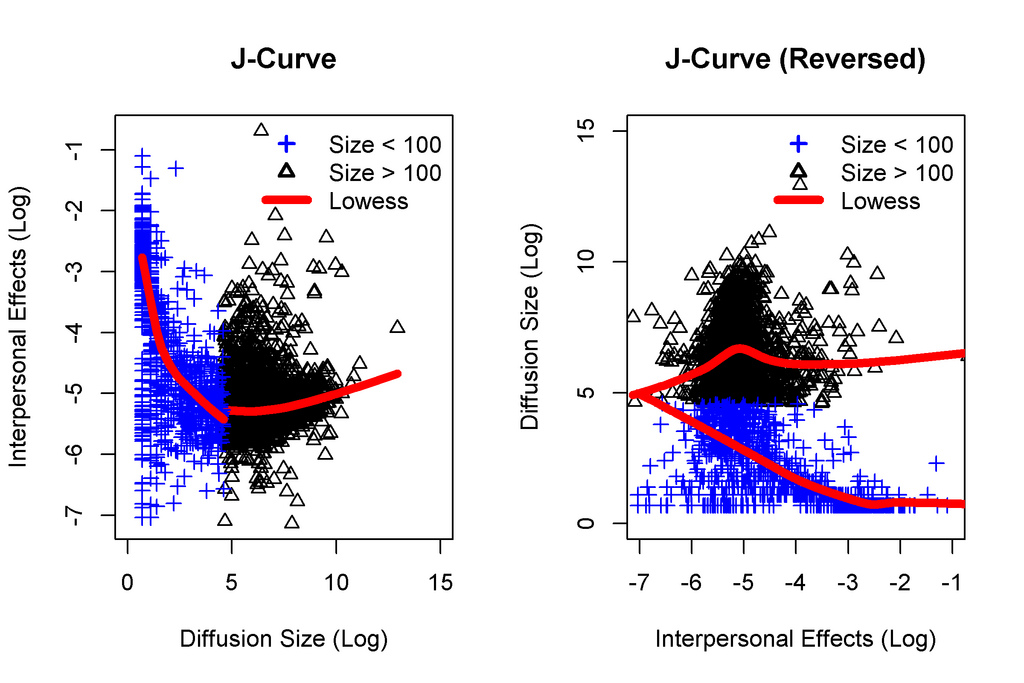
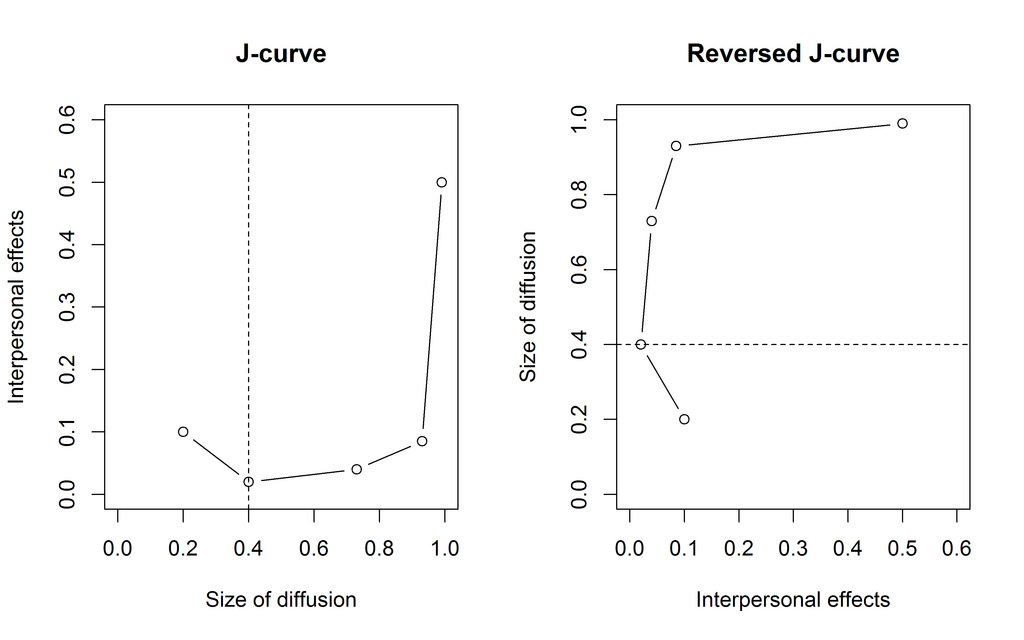
J-curve of news diffusion
The J-curve model illustrates that there is a nonlinear relationship
between interpersonal effects and diffusion size (Greenberg, 1964;
MaQuail & Windahl, 1993).
1. for the information of less importance, there is a negative relationship
between interpersonal effects and diffusion size;
2. while for those information of larger salience, there is a positive
relationship between interpersonal effects and diffusion size.
Two regimes of social influence exist in the diffusion of Facebook applications
(Onnela & Reed-Tsochas, 2010)
between interpersonal effects and diffusion size (Greenberg, 1964;
MaQuail & Windahl, 1993).
1. for the information of less importance, there is a negative relationship
between interpersonal effects and diffusion size;
2. while for those information of larger salience, there is a positive
relationship between interpersonal effects and diffusion size.
Two regimes of social influence exist in the diffusion of Facebook applications
(Onnela & Reed-Tsochas, 2010)
H1b: the relationship between
interpersonal effects and diffusion
size is curvilinear.
interpersonal effects and diffusion
size is curvilinear.
Diffusion depth
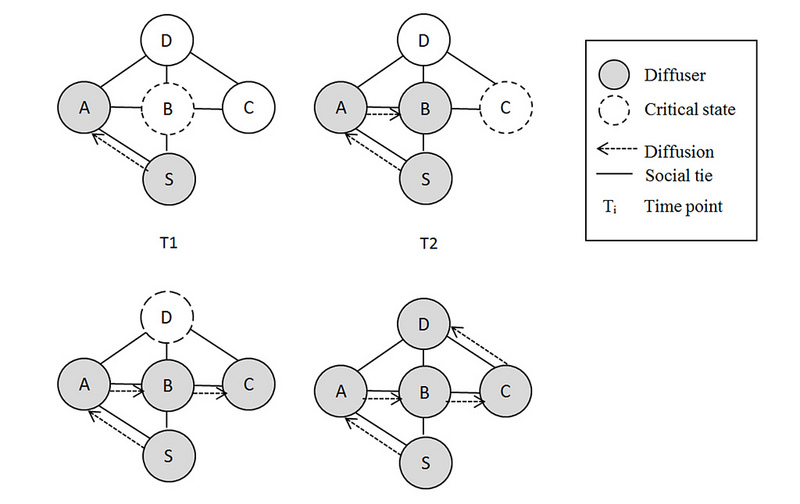
Information diffusion through social networks is a chain-reaction
process. The contagion may “infect” the local community effectively, and stop
trigger further diffusions.
There exists structural bottlenecks (Borge-Holthoefer, Baños,
González-Bailón, & Moreno, 2013).
process. The contagion may “infect” the local community effectively, and stop
trigger further diffusions.
There exists structural bottlenecks (Borge-Holthoefer, Baños,
González-Bailón, & Moreno, 2013).
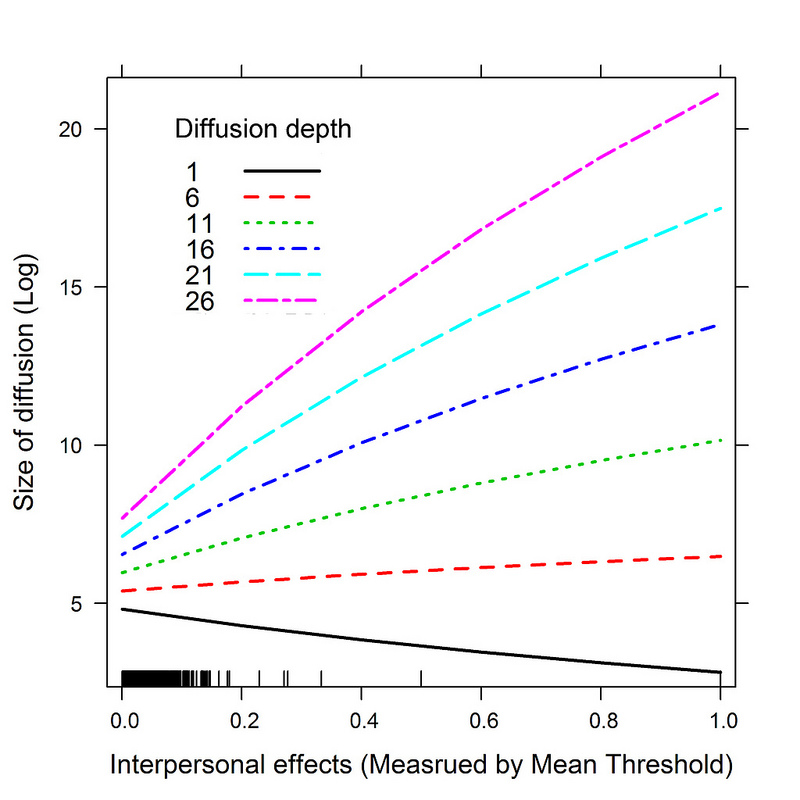
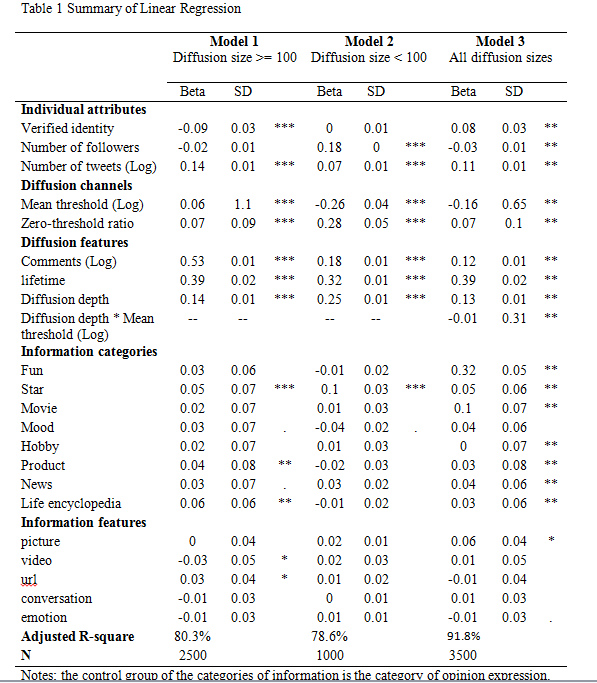
H2a: The depth of information diffusion has
positive influence on the size of information diffusion.
H2b: The depth of information diffusion moderates
the interpersonal effects on the size of information diffusion.
positive influence on the size of information diffusion.
H2b: The depth of information diffusion moderates
the interpersonal effects on the size of information diffusion.
If the bridging nodes have a higher resistance to retweet
it can spread information to new communities
diffusion depth can substantially amplify or limit the interpersonal effects
it can spread information to new communities
diffusion depth can substantially amplify or limit the interpersonal effects
The other hypotheses
H3a: the popularity of submitters is positively related to the size of information diffusion.
H3b: the activity of submitters is positively related to the size of information diffusion.
H4: the number of comments is positively correlated with the size of information diffusion.
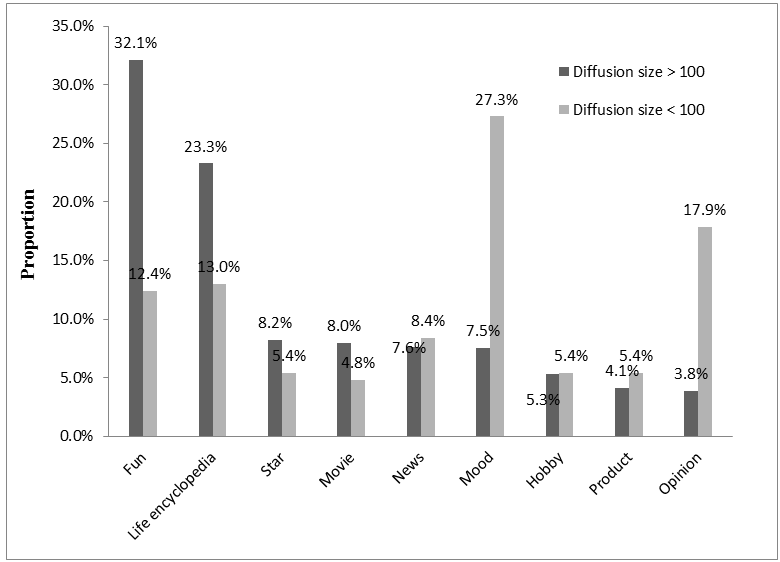
H5: the category of information has significant influence on the size of information diffusion.
RQ1: whether tweets of opinion expression can spread to a wider audience than the other
categories of information?
H6: the information embedded with rich media (e.g., url, image, video, and emotions)
tends to increase the size of information diffusion.
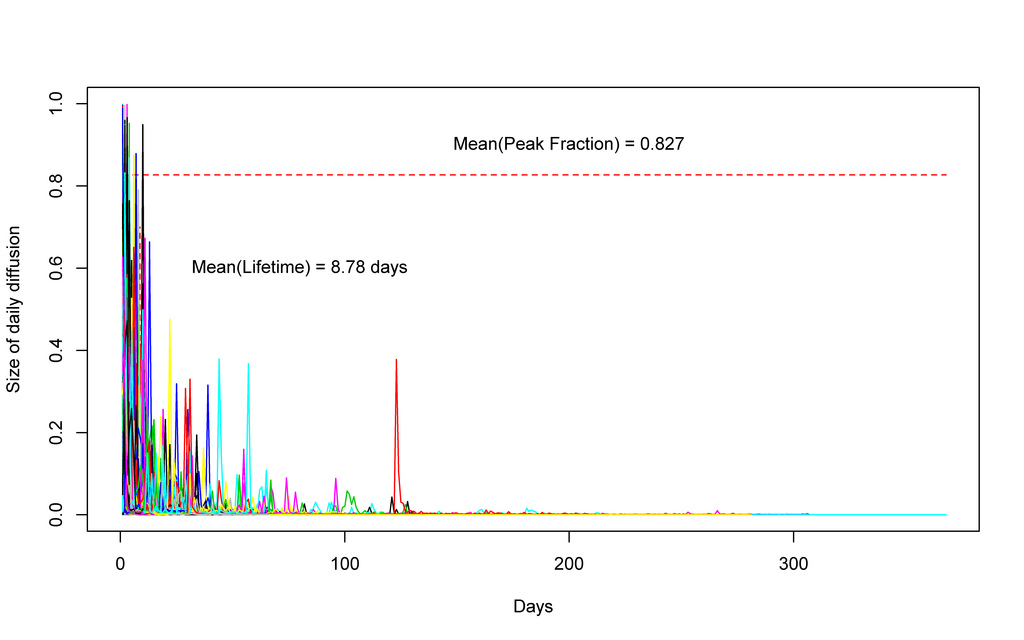
H7: Lifetime of information diffusion is positively related to the size of information diffusion.
H3b: the activity of submitters is positively related to the size of information diffusion.
H4: the number of comments is positively correlated with the size of information diffusion.
H5: the category of information has significant influence on the size of information diffusion.
RQ1: whether tweets of opinion expression can spread to a wider audience than the other
categories of information?
H6: the information embedded with rich media (e.g., url, image, video, and emotions)
tends to increase the size of information diffusion.
H7: Lifetime of information diffusion is positively related to the size of information diffusion.
Method
We randomly generate 300 million Weibo user ids in June 2012 using the method
of random digital search (Zhu, Mo, Wang, & Lu, 2011), and detect the existence of
these user ids, which yields a random sample of 62.3 thousands Weibo users, and
all of their tweets (N = 5.04 million) are crawled.
To quantify the degree distribution of information diffusion, I sample 600
thousand tweets from the corpus, and collected the number of
retweets/comments/favorites for these tweets through
the API of Sina Weibo (Weibo, 2012).
Further, to study the information diffusion with regression models,
I collect the diffusion network and their following graph for 8.5 thousand
tweets. Among which, the content of 3500 tweets are coded.
of random digital search (Zhu, Mo, Wang, & Lu, 2011), and detect the existence of
these user ids, which yields a random sample of 62.3 thousands Weibo users, and
all of their tweets (N = 5.04 million) are crawled.
To quantify the degree distribution of information diffusion, I sample 600
thousand tweets from the corpus, and collected the number of
retweets/comments/favorites for these tweets through
the API of Sina Weibo (Weibo, 2012).
Further, to study the information diffusion with regression models,
I collect the diffusion network and their following graph for 8.5 thousand
tweets. Among which, the content of 3500 tweets are coded.
This is the end.
Thank you.
Thank you.
chengjun.github.io